

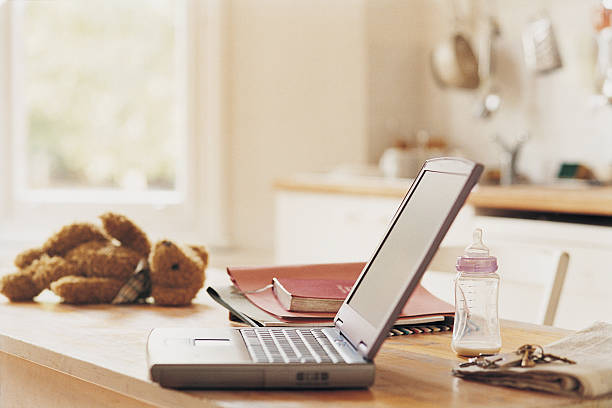
You have answered an email while stirring pasta with one hand, helped a toddler find a missing toy during a video call, and typed up a report with a baby asleep on your chest. You have done the dishes at midnight simply because it was the first quiet moment you had all day. If this sounds familiar, you already know that working from home while raising children blurs every line you thought existed between professional and personal life. But here is a gentle truth that many of us forget: you are allowed to close the door.
Creating a physical boundary at home is one of the most powerful ways to manage daily stress, and yet it can feel like an act of defiance. We worry that shutting ourselves away means we are being cold or neglectful. We imagine our children feeling abandoned or our partners thinking we have checked out. In reality, a closed door is not a wall against your family—it is a shield around your focus and a gift of your full attention later. When you protect your work time, you protect the energy and patience you need to be fully present when your workday ends.
Think about the spaces in your home. Even a small corner can become a sanctuary. A desk tucked into a hallway, a chair beside a window, or a closet converted into a tiny office can signal to your brain that this is the place for focused work. When you sit in that spot, you are training yourself to shift into professional mode. And when you leave that spot, you are training yourself to let it go. The physical separation helps your mind find the same separation. But for this to work, the boundary must be respected—by you first, and then by everyone else.
This means having gentle conversations with your family. Let your children know that when the door is closed, you are working just like they are at school or at play. Use a simple signal: a colored sign, a lamp turned on, or a pair of headphones. Explain that you love them so much that you want to give your full focus to your tasks so you can give your full focus to them afterward. With older children, you can even invite them to help remind each other. “Mommy’s door is closed right now, so we can wait until she comes out.” This teaches them respect for boundaries too, a skill they will carry into their own lives.
For mothers of very young children, this can be especially challenging. Sometimes the door stays open a crack, and that is okay. The goal is not perfection—it is intention. If you can get even twenty minutes of uninterrupted time, that is a win. Use a visual timer so your toddler can see when you will be done. Let them wave through the crack if they need to, but practice saying, “I will be finished in five minutes, and then we will play.” Over time, they learn that your attention is not forever lost—it is simply delayed. And delayed attention, given fully, is far more nourishing than fragmented attention shared with a dozen distractions.
Do not underestimate the role your partner or a trusted older child can play. If you share your home with someone else, ask them to be the first responder for interruptions during your designated work hours. This is not about avoiding your parental duties; it is about dividing them strategically so that everyone’s needs are met. When you know that someone else is handling the snack requests or the spilled water, your nervous system can relax enough to enter a productive state. That relaxation is a key part of stress management.
You may also need to set boundaries with yourself. It is easy to peek at work emails during dinner or check notifications while reading a bedtime story. Giving yourself a physical boundary means committing to it. When your work time ends, close the laptop, leave the phone in the office, and walk away. Let your family see you transition. This visible shift teaches them that you are now fully theirs. And it teaches you that you deserve to rest.
Remember that this boundary does not have to be rigid forever. Some days the door will stay open. Some days you will work from the sofa while a sick child naps beside you. That is not failure—that is life. The point is to have a default practice that supports your wellbeing, so that when flexibility is needed, you have a foundation to return to. A closed door is not a lock. It is an invitation for everyone in your home to understand that your time and energy are valuable. And when you honor that, you teach your children to honor their own boundaries as they grow.
So take a deep breath. Find your spot. Close the door for just a little while. Your work will get done. Your children will be fine. And you will emerge with a little more peace in your heart.