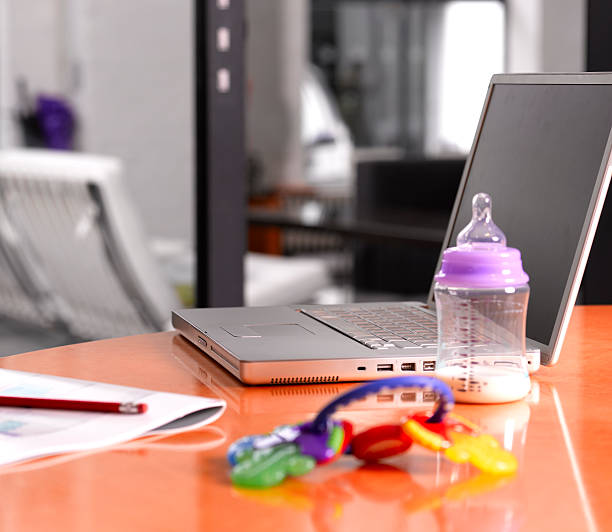


There is a moment that many of us know well, that quiet pinch in the middle of a Tuesday afternoon. You are in your home office, or maybe at a desk in the corner of the living room, and you hear the soft hum of the washing machine finishing its cycle. You glance at the clock. The school bus arrives in forty-five minutes. Your to-do list for work is still half full, and your child’s permission slip is somewhere in the bottom of a backpack that you have been meaning to sort for three days. In that moment, the old voice of guilt whispers that you should be doing everything better, faster, and all at once. But what if the truest form of career flexibility is not about doing more, but about surrendering to the rhythm of your own days?
When we talk about flexibility in our careers, it is easy to imagine a single, perfect schedule that unlocks all the answers. We dream of a job that starts at nine and ends at three, with no emails on weekends and a quiet office with a door that actually closes. But for most mothers, that perfect picture is a fantasy. The real work of flexibility is not about finding the ideal container for your life. It is about finding the small, daily permissions to bend and sway without breaking. This is the heart of what we might call micro-flexibility.
Micro-flexibility is the art of making tiny, almost invisible adjustments to your workday that protect your energy and your presence. It is not about overhauling your entire career or quitting your job to start a cottage industry selling hand-painted tea towels. That kind of dramatic change is wonderful for some, but it is not accessible or desirable for everyone. Micro-flexibility is for the mother who needs to start her workday an hour later because her youngest has been waking up with bad dreams. It is for the mother who needs to step away from her desk for ten minutes at two in the afternoon to sit on the porch and watch the clouds with her child. It is for the mother who blocks out an hour on her calendar every Thursday for absolutely nothing, just in case the engine light comes on or a baby gets a fever.
This approach requires us to let go of a very specific kind of perfectionism. Many of us were raised on the belief that a good worker is always available and a good mother is never distracted. These two beliefs create a terrible tension inside us. Micro-flexibility invites us to loosen that grip. It suggests that a half-hour of focused work, followed by fifteen minutes of helping with a puzzle, is often more productive for both your spirit and your career than three hours of distracted, guilt-ridden effort.
How do we begin to practice this? The first step is to negotiate with yourself, not just with your employer. You can begin by taking a quiet inventory of your day. Where are the places where you are fighting against the current? Perhaps you are fighting the fact that you have the most energy in the early morning, yet you force yourself to answer emails first thing. Or maybe you are fighting the reality that late afternoon is a low-energy slump for you, yet you schedule your most demanding meetings then. Micro-flexibility means moving with your own energy, not against it. If you can shift your hardest task to the hour when you feel sharpest, you have already created a small, powerful permission slip for yourself.
Another quiet revolution is learning to integrate your roles rather than trying to separate them. The myth of work-life balance suggests that the two halves of your life should sit perfectly on either side of a clean line. But life is not a seesaw. It is a river. Sometimes you need to bring a piece of your work life into your family time, and sometimes you need to bring your family’s love into your work time. Let your child draw a picture next to you while you type an email. Let yourself feel the warmth of that connection even as you meet your professional obligations. This integration is a form of flexibility that costs nothing and returns everything.
For the mother who works outside the home, micro-flexibility might look like asking for a later start time on the days your partner has an early meeting. It might look like requesting permission to eat lunch at your desk so you can leave thirty minutes earlier. It looks like accepting that you do not have to volunteer for every extra project. For the mother who works from home, it might look like giving yourself permission to close the laptop during the last hour before dinner, even if you plan to open it again after bedtime. It is about trusting that you know your own life better than any corporate handbook ever could.
The goal is not to build a perfect career. The goal is to build a career that can breathe with you. When you allow yourself these small adjustments, you are teaching your children something far more valuable than any lesson in time management. You are teaching them that life is not about rigid schedules and ruthless efficiency. It is about kindness, especially the kindness you show yourself. So tomorrow morning, when you feel that familiar pinch between work and family, pause. Ask yourself a gentle question. What small shift could I make right now that would let me move through my day with a little more softness and a little less strain? The answer is your flexibility. It has been there all along, waiting for you to let it in.